
Virtual Reality & Theraputic References Cited in our Research Plans
Scientific Evidence points towards success probability of Virtual Reality Theraputics in Chronic Stress modification.
Dr. Alicia Mckoy, Hon.Ph.D.
5/6/20269 min read
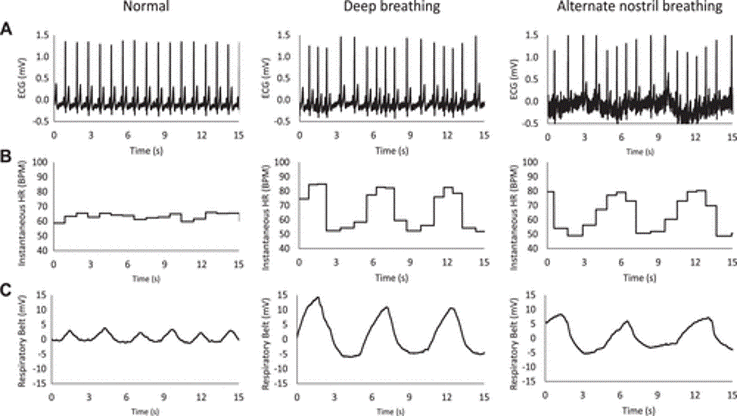
Some of our Cited References:
AccessHope. (2023). Employer Benefits. Retrieved from https://www.myaccesshope.org/
Adisa TA, Antonacopoulou E, Beauregard TA, Dickmann M, Adekoya OD. Exploring the Impact of COVID‐19 on Employees’ Boundary Management and Work–Life Balance. British Journal of Management. 2022 Oct;33(4):1694–709. doi: 10.1111/1467-8551.12643. Epub 2022 Jul 19. PMCID: PMC9350308.
Aldana S. G. (2001). Financial impact of health promotion programs: a comprehensive review of the literature. American journal of health promotion : AJHP, 15(5), 296–320. https://doi.org/10.4278/0890-1171-15.5.296
American Heart Association. (2023). Guidelines. Retrieved from https://professional.heart.org/en/guidelines-and-statements
American Institute of Stress. (2023). Workplace Stress. Retrieved from https://www.stress.org/workplace-stress
American Psychiatric Association, DSM-5 Task Force. (2013). Diagnostic and statistical manual of mental disorders: DSM-5™ (5th ed.). American Psychiatric Publishing, Inc.. https://doi.org/10.1176/appi.books.9780890425596
American Psychiatric Association, The Strait-Trait Anxiety Inventory. Retrieved from https://www.apa.org/pi/about/publications/caregivers/practice-settings/assessment/tools/trait-state
American Psychological Association. (2023). Stress in America 2023: A nation recovering from collective trauma. Retrieved from https://www.apa.org/news/press/releases/stress/2023/collective-trauma-recovery
Baicker, K., Cutler, D., & Song, Z. (2010). Workplace wellness can generate savings. Health Affairs, 29(2), 304–311. https://doi.org/10.1377/hlthaff.2009.0626
Bonifacci, P., Desideri, L., & Ottaviani, C. (2015). Familiarity of Faces: Sense or Feeling?: An Exploratory Investigation With Eye Movements and Skin Conductance. Journal of Psychophysiology, 29(1), 20–25. https://doi.org/10.1027/0269-8803/a000130
Boucsein, W. (2012). Electrodermal activity. Springer Science & Business Media. https://doi.org/10.1007/978-1-4614-1126-0
Boucsein W., Fowles D. C., Grimnes S., Ben-Shakhar G., Roth W. T., Dawson M. E., Filion D. L. (2012). Society for Psychophysiological Research Ad Hoc Committee on Electrodermal Measures. Publication recommendations for electrodermal measurements.
Brown, D. K., Barton, J. L., & Gladwell, V. F. (2013). Viewing nature scenes positively affects recovery of autonomic function following acute-mental stress. Environmental Science & Technology, 47(11), 5562–5569.
Brouwer, A. M., Hogervorst, M. A., Holewijn, M., & van Erp, J. B. F. (2014). Evidence for effects of task difficulty but not learning on neurophysiological variables associated with effort. International Journal of Psychophysiology, 93(2), 242–252. https://doi.org/10.1016/j.ijpsycho.2014.05.004
Bui, T., Zackula, R., Dugan, K., & Ablah, E. (2021). Workplace Stress and Productivity: A Cross-Sectional Study. Kansas journal of medicine, 14, 42–45. https://doi.org/10.17161/kjm.vol1413424
Chae Heon Lim & Seul Chan Lee. (2023) The Effects of Degrees of Freedom and Field of View on Motion Sickness in a Virtual Reality Context. International Journal of Human–Computer Interaction 0:0, pages 1-13.
Cohen et al. (2007). Psychosomatic Medicine. Retrieved from https://psycnet.apa.org/record/2007-05446-000
Covey, T. J., Shucard, J. L., Violanti, J. M., Lee, J., & Shucard, D. W. (2013). The effects of exposure to traumatic stressors on inhibitory control in police officers: a dense electrode array study using a Go/NoGo continuous performance task. International journal of psychophysiology : official journal of the International Organization of Psychophysiology, 87(3), 363–375. https://doi.org/10.1016/j.ijpsycho.2013.03.009
Dascal, J., et al. Virtual Reality and Medical Inpatients: A Systematic Review of Randomized, Controlled Trials. Innov Clin Neurosci. 2017; 14(1-2): 14-21
De Kort, Y., Meijnders, A., Sponselee, A., & IJsselsteijn, W. (2006). What's wrong with virtual trees? Restoring from stress in a mediated environment. Journal of Environmental Psychology, 26(4), 309–320.
Dhama K, Latheef SK, Dadar M, Samad HA, Munjal A, Khandia R, Karthik K, Tiwari R, Yatoo MI, Bhatt P, Chakraborty S, Singh KP, Iqbal HMN, Chaicumpa W, Joshi SK. Biomarkers in Stress Related Diseases/Disorders: Diagnostic, Prognostic, and Therapeutic Values. Front Mol Biosci. 2019 Oct 18;6:91. doi: 10.3389/fmolb.2019.00091. PMID: 31750312; PMCID: PMC6843074.
Diette, G. B., Lechtzin, N., Haponik, E., Devrotes, A., & Rubin, H. R. (2003). Distraction therapy with nature sights and sounds reduces pain during flexible bronchoscopy: a complementary approach to routine analgesia. Chest, 123(3), 941–948. https://doi.org/10.1378/chest.123.3.941
Epel, E. S., Crosswell, A. D., Mayer, S. E., et al. (2018). More than a feeling: A unified view of stress measurement for population science. Frontiers in Neuroendocrinology, 49, 146–169. https://doi.org/10.1016/j.yfrne.2018.03.001
Epub 2012 Jun 8. PMID: 22680988. (2012), Publication standards for EDA. Psychophysiology, 49: 1017-1034. https://doi.org/10.1111/j.1469-8986.2012.01384.x
Eunhee Chang, Yongjae Lee & Byounghyun Yoo. (2023) A User Study on the Comparison of View Interfaces for VR-AR Communication in XR Remote Collaboration. International Journal of Human–Computer Interaction 0:0, pages 1-16.
Felmingham, K. L., Rennie, C., Manor, B., & Bryant, R. A. (2011). Eye tracking and physiological reactivity to threatening stimuli in posttraumatic stress disorder. Journal of Anxiety Disorders, 25(5), 668–673. https://doi.org/10.1016/j.janxdis.2011.02.010
Fisher, J. (2023, June 20). As workforce well-being dips, leaders ask: What will it take to move the needle? Deloitte. Retrieved from www2.deloitte.com/us/en/insights/topics/talent/workplace-well-being-research.html
Gallup. (2023). The Economic Cost of Poor Employee Mental Health. Retrieved from https://www.gallup.com/workplace/404174/economic-cost-poor-employee-mental-health.aspx
Garrido LE, Frías-Hiciano M, Moreno-Jiménez M, Cruz GN, García-Batista ZE, Guerra-Peña K, Medrano LA. Focusing on cybersickness: pervasiveness, latent trajectories, susceptibility, and effects on the virtual reality experience. Virtual Real. 2022;26(4):1347-1371. doi: 10.1007/s10055-022-00636-4. Epub 2022 Mar 1. PMID: 35250349; PMCID: PMC8886867.
Gold, J. I., Kim, S. H., Kant, A. J., Joseph, M. H., & Rizzo, A. S. (2006). Effectiveness of virtual reality for pediatric pain distraction during i.v. placement. Cyberpsychology & behavior : the impact of the Internet, multimedia and virtual reality on behavior and society, 9(2), 207–212. https://doi.org/10.1089/cpb.2006.9.207
Gomes, N., Pato, M., Lourenço, A. R., & Datia, N. (2023). A Survey on Wearable Sensors for Mental Health Monitoring. Sensors, 23(3), 1330. https://doi.org/10.3390/s23031330
Grand View Research. (2023). U.S. Corporate Wellness Market Size, Share & Trends Analysis Report By Service (Health Risk Assessment, Fitness), By End Use, By Category, By Delivery Model (Onsite, Offsite), By Region, And Segment Forecasts, 2023 - 2030. Retrieved from https://www.grandviewresearch.com/industry-analysis/us-corporate-wellness-market
Hopkins, L. S., Schultz, D. H., Hannula, D. E., & Helmstetter, F. J. (2015). Eye Movements Index Implicit Memory Expression in Fear Conditioning. PLOS ONE, 10(11), e0141949. https://doi.org/10.1371/journal.pone.0141949
IBM. (2023). Cost of a Data Breach. Retrieved from https://www.ibm.com/downloads/cas/E3G5JMBP
Johnson, S. S. (2020). The Future of Work. American Journal of Health Promotion, 34(7), 809–812. https://doi.org/10.1177/0890117120943748a
Katmah, R., Al-Shargie, F., Tariq, U., Babiloni, F., Al-Mughairbi, F., & Al-Nashash, H. (2021). A Review on Mental Stress Assessment Methods Using EEG Signals. Sensors (Basel), 21(15), 5043. https://doi.org/10.3390/s21155043
Kessler, R. C., Berglund, P., Demler, O., et al. (2010). The Lancet Psychiatry.
Kim, H., Kim, D. J., Kim, S., Chung, W. H., Park, K. A., Kim, J. D. K., Kim, D., Kim, M. J., Kim, K., & Jeon, H. J. (2021). Effect of Virtual Reality on Stress Reduction and Change of Physiological Parameters Including Heart Rate Variability in People With High Stress: An Open Randomized Crossover Trial. Frontiers in psychiatry, 12, 614539.
Kundi, Y. M., Aboramadan, M., Elhamalawi, E. M. I., & Shahid, S. (2021). Employee psychological well-being and job performance: Exploring mediating and moderating mechanisms. International Journal of Organizational Analysis, 29(3), 736-754. https://doi.org/10.1108/IJOA-05-2020-2204
Leigh, J. P. (2011). Economic burden of occupational injury and illness in the United States. The Milbank Quarterly, 89, 728-772. https://doi.org/10.1111/j.1468-0009.2011.00648.x
Mariotti A. The effects of chronic stress on health: new insights into the molecular mechanisms of brain-body communication. Future Sci OA. 2015 Nov 1;1(3):FSO23. doi: 10.4155/fso.15.21. PMID: 28031896; PMCID: PMC5137920.
McKinsey & Company. (2020). Diverse Employees Are Struggling the Most During COVID-19: Here's How Companies Can Respond. Retrieved from https://www.mckinsey.com/featured-insights/diversity-and-inclusion/diverse-employees-are-struggling-the-most-during-covid-19-heres-how-companies-can-respond
Mental Health America. (2021). Mind the Workplace. Retrieved from https://mhanational.org/sites/default/files/Mind%20the%20Workplace%20-%20MHA%20Workplace%20Health%20Survey%202021%202.12.21.pdf
Miliken Institute. (2016). The Costs of Chronic Disease in the U.S.. Retrieved from https://milkeninstitute.org/report/costs-chronic-disease-us
Mott, J., Bucolo, S., Cuttle, L., Mill, J., Hilder, M., Miller, K., & Kimble, R. M. (2008). The efficacy of an augmented virtual reality system to alleviate pain in children undergoing burns dressing changes: a randomised controlled trial. Burns : journal of the International Society for Burn Injuries, 34(6), 803–808. https://doi.org/10.1016/j.burns.2007.10.010
National Institute for Occupational Safety and Health. (2009). Work Life Initiative: Essential elements of effective workplace programs and policies for improving worker health and wellbeing. DHHS (NIOSH) PUBLICATION NUMBER 2010-140
Parsons, T. D. (2021). Ethical Challenges of Using Virtual Environments in the Assessment and Treatment of Psychopathological Disorders. Journal of Clinical Medicine, 10(3), 378. https://doi.org/10.3390/jcm10030378
Perez-Valero, E., Vaquero-Blasco, M. A., Lopez-Gordo, M. A., & Morillas, C. (2021). Quantitative Assessment of Stress Through EEG During a Virtual Reality Stress-Relax Session. Frontiers in Computational Neuroscience, 15, 684423. https://doi.org/10.3389/fncom.2021.684423
Phillips, E. A., Gordeev, V. S., & Schreyögg, J. (2019). Effectiveness of occupational e-mental health interventions: a systematic review and meta-analysis of randomized controlled trials. Scandinavian Journal of Work, Environment & Health, 45(6), 560–576. https://doi.org/10.5271/sjweh.3839
Regier, D.A., Kuhl, E.A. and Kupfer, D.J. (2013), The DSM-5: Classification and criteria changes. World Psychiatry, 12: 92-98. https://doi.org/10.1002/wps.20050
Schneider, S. M., & Hood, L. E. (2007). Virtual reality: A distraction intervention for chemotherapy. Oncology Nursing Forum, 34(1), 39-46. https://doi.org/10.1188/07.ONF.39-46
Schmitt, Y. S., Hoffman, H. G., Blough, D. K., Patterson, D. R., Jensen, M. P., Soltani, M., Carrougher, G. J., Nakamura, D., & Sharar, S. R. (2011). A randomized, controlled trial of immersive virtual reality analgesia, during physical therapy for pediatric burns. Burns : journal of the International Society for Burn Injuries, 37(1), 61–68. https://doi.org/10.1016/j.burns.2010.07.007
Sears, L. E., Shi, Y., Coberley, C. R., & Pope, J. E. (2013). Overall well-being as a predictor of health care, productivity, and retention outcomes in a large employer. Population Health Management, 16(6), 397-405. https://doi.org/10.1089/pop.2012.0114
Segerstrom, S. C., & Miller, G. E. (2004). Psychological stress and the human immune system: a meta-analytic study of 30 years of inquiry. Psychological bulletin, 130(4), 601–630. https://doi.org/10.1037/0033-2909.130.4.601
Smith, et al. (2022). Greiner BA, Leduc C, O’Brien C, Cresswell-Smith J, Rugulies R, Wahlbeck K, et al. (2022) The effectiveness of organizational-level workplace mental health interventions on mental health and well-being in construction workers: A systematic review and recommended research agenda. PLoS ONE, 17(11), e0277114. https://doi.org/10.1371/journal.pone.0277114
Society for Human Resource Management. (2023). Burnout: How Workplace Mental Health Extends Beyond Work. Retrieved from https://www.shrm.org/about-shrm/press-room/press-releases/pages/burnout-how-workplace-mental-health-extends-beyond-work-.aspx
Sonnentag, S., Tay, L., & Nesher Shoshan, H. (2023). A review on health and well-being at work: more than stressors and strains. Personnel Psychology, 76, 473–510. https://doi.org/10.1111/peps.12572
Søvold, L. E., Naslund, J. A., Kousoulis, A. A., et al. (2021). Prioritizing the Mental Health and Well-Being of Healthcare Workers: An Urgent Global Public Health Priority. Frontiers in Public Health, 9, 679397. https://doi.org/10.3389/fpubh.2021.679397
Tomitani, N., Kanegae, H., Suzuki, Y., Kuwabara, M., & Kario, K. (2021). Stress-Induced Blood Pressure Elevation Self-Measured by a Wearable Watch-Type Device. American Journal of Hypertension, 34(4), 377–382. https://doi.org/10.1093/ajh/hpaa139
Tursky, B., Shapiro, D., & Crider, A. & Kahneman, D. (1969). Pupillary, heart rate, and skin resistance changes during a mental task. Journal of Experimental Psychology, 79(1p1), 79. 164-7. https://doi.org/10.1037/h0026952
United States Government Accountability Office. (2022, March). Mental Health Care: Access Challenges for Covered Consumers and Relevant Federal Efforts. Report to the Chairman, Committee on Finance, U.S. Senate. https://www.gao.gov/assets/gao-22-104597.pdf
Urry, H. L. (2010). Seeing, thinking, and feeling: Emotion-regulating effects of gaze-directed cognitive reappraisal. Emotion, 10(1), 125–135. https://doi.org/10.1037/a0017434
U.S. Department of Health and Human Services. (2022). Surgeon General’s Report on a New Framework for Mental Health & Well-Being in the Workplace. [Retrieved from https://www.hhs.gov/surgeongeneral/priorities/workplace-well-being/index.html]
U.S. Bureau of Labor Statistics. (2023). CPI Inflation Calculator. Retrieved from https://www.bls.gov/data/inflation_calculator.htm
University of Massachusetts Lowell. (2023). Financial Costs of Job Stress. Retrieved from https://www.uml.edu/research/cph-new/worker/stress-at-work/financial-costs.aspx
van der Feltz-Cornelis, C. M., Shepherd, J., Gevaert, J., et al. (2023). Design and development of a digital intervention for workplace stress and mental health (EMPOWER). Internet Interventions, 34, 100689. https://doi.org/10.1016/j.invent.2023.100689
Vanhollebeke, G., De Smet, S., De Raedt, R., Baeken, C., van Mierlo, P., & Vanderhasselt, M. A. (2022). The neural correlates of psychosocial stress: A systematic review and meta-analysis of spectral analysis EEG studies. Neurobiology of Stress, 18, 100452. https://doi.org/10.1016/j.ynstr.2022.100452
Vujovic, L., Opitz, P. C., Birk, J. L., & Urry, H. L. (2014). Cut! that’s a wrap: regulating negative emotion by ending emotion-eliciting situations. Frontiers in Psychology, 5. https://doi.org/10.3389/fpsyg.2014.00165
Wiemer, J., Gerdes, A. B. M., & Pauli, P. (2013). The effects of an unexpected spider stimulus on skin conductance responses and eye movements: an inattentional blindness study. Psychological Research, 77(2), 155–166. https://doi.org/10.1007/s00426-011-0407-7
Wieser, M. J., Pauli, P., Alpers, G. W., & Mühlberger, A. (2009). Is eye to eye contact really threatening and avoided in social anxiety?—An eye-tracking and psychophysiology study. Journal of Anxiety Disorders, 23(1), 93–103. https://doi.org/10.1016/j.janxdis.2008.04.004
Woods, E. H., Zhang, Y., Roemer, E. C., Kent, K. B., Davis, M. F., & Goetzel, R. Z. (2023). Addressing Psychosocial, Organizational, and Environmental Stressors Emerging From the COVID-19 Pandemic and Their Effect on Essential Workers' Mental Health and Well-being: A Literature Review. Journal of occupational and environmental medicine, 65(5), 419–427. https://doi.org/10.1097/JOM.0000000000002802
Work Institute. (2023). 2022 Retention Report: How Employers Caused the Great Resignation. Retrieved from https://info.workinstitute.com/hubfs/2022%20Retention%20Report/2022%20Retention%20Report%20-%20Work%20Institute.pdf
World Economic Forum. (2021, January). Priority Workplaces in the New Normal: Wellbeing. Retrieved from https://www.weforum.org/agenda/2021/01/priority-workplaces-new-normal-wellbeing/
Zhang, D., Lee, E. K. P., Mak, E. C. W., Ho, C. Y., & Wong, S. Y. S. (2021). Mindfulness-based interventions: an overall review. British Medical Bulletin, 138(1), 41–57. https://doi.org/10.1093/bmb/ldab005
Zappalà, S., Swanzy, E. K., & Toscano, F. (2022). Workload and Mental Well-Being of Homeworkers: The Mediating Effects of Work-Family Conflict, Sleeping Problems, and Work Engagement. Journal of Occupational and Environmental Medicine, 64(10), e647-e655. https://doi.org/10.1097/JOM.0000000000002659
Contact
Reach out for VRx well-being pilots and studies today
Phone
Connect@ThriveXReality.com
+1-317-499-6879
© 2026. All rights reserved.
Disclaimer: These statements have not been evaluated by the Food and Drug Administration or MHRA. Peak Mind products and recommended hardware are wellness devices intended to help manage stress, challenging days, and to promote a healthy lifestyle. Peak Mind products are not intended to diagnose, treat, cure, or prevent any disease. Use only as directed. The information provided herein is intended for your general knowledge only and is not intended to be, nor is it, medical advice or a substitute for medical advice. If you have a specific medical condition or disease, this device is not intended to treat that condition. ThriveXR is not commercially available in market today, we are in piloting and clinical research phases.